Distractions…

I sent off my one page project summary to the Ministry of Education and am waiting to hear back from them. So, in the meantime, I decided to distract myself this week by  looking at flight options. So if you’re not interested in exploring all the ways you can to Uzbekistan, you should probably just stop reading now.

Let’s start with the flight options.  Tashkent is not an easy place to get to from Minnesota. I’ve done some preliminary research on the best routes for us to take and am a bit flummoxed.  Due to the “Fly America Act” we have to fly on a US carrier or one of its partners for as much of the trip as possible. That’s fine with me as I’d prefer to fly Delta over Turkish airlines anyway.  I started with a basic search on Travelocity without much success. Nearly every option that comes up goes West to South Korea and then to Tashkent.  This is not a good option. The flights require multiple connections and take anywhere from 32 to 46 hours. That’s right folks, almost 2 days of just flights and layovers.

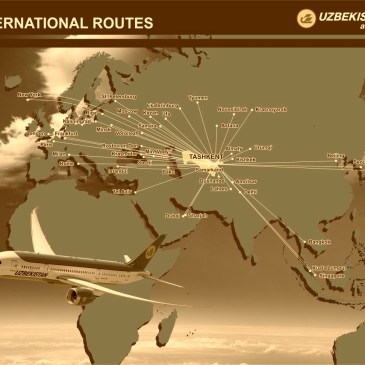
Another option is to fly to Europe on a US based airline and then connect via Uzbek Airways. This option is a little more complicated for me to sort out though as the Uzbek Airlines flight, as far as I can tell, will have to be booked directly through their website AND our return flight date isn’t until sometime in June. Right now Uzbek airlines is only booking out through March. This means that I can’t look at actual flights that are available.  Still, I can see the flight routes and the European cities that Uzbek Airlines has direct flights to Tashkent. My best options appear to be to fly from Rome, Milan, London, or Frankfurt directly to Tashkent. If we connect in London the flight to Tashkent is about 7 hours.  A flight from either Italy or Germany is about 6 hours.

Now a plan is forming in my mind. Because of the long travel time and the need to connect in Europe, I’m thinking we might be better off flying to Europe early and spend a few days being tourists before getting our connection to Tashkent via Uzbek airlines.  That sounds that a much better option than spending around 40 hours in airports or on an airplane.

And by the way, as I’m writing this, my son is watching an episode of “Air Disasters” on TV. I just watched all about how an Asia Airlines flight dropped out of the sky and plunged into the ocean, killing everyone on board, due to pilot error. Um…So I’m not feeling so great about all this flying after all…

A Project in the Making

More exciting new this week!

My contact at the US Embassy in Tashkent emailed me again. This time she wanted to let me know that just as she was getting ready to submit a request for me to be placed at the teacher’s college in Tashkent, she received a request from the Ministry of Education to have someone help them create an anti-bullying program in their schools. She didn’t have any details but was wondering if I would be interested in something like this. Given my background in school psychology this certainly does fall within my skill set, but it has been a long time since I’ve done any work in a K-12 setting.

As has been my way with everything Fulbright so far, I said, “Of Course!” and asked to be put in contact with the Ministry of Education. To my surprise I received an email the very next day from a person at the Ministry, who was herself a Fulbright scholar in the US. We exchanged contact information and arranged a phone call via the Telegram app I’m told everyone in Uzbekistan is on Telegram.

The app worked great for a voice call. It really is remarkable how easy it is now to make phone calls pretty much anywhere in the world, for free! We had a great conversation today. So if you want to stay in touch with me while I am in Uzbekistan I suggest that you download Telegram.

The Ministry of Education is looking for help supporting their school psychologists and developing some crisis intervention tools. This is a really exciting project because it is just getting starting and there is so much to contribute to this effort. This week I need to write-up a general overview of what I think I might be able to accomplish in my five months there.  While I am working on that, the person I will be working with at the Ministry of Education is going to contact a few of the school psychologists and ask them to provide more information to me about what type of support they would find most useful.

If this project works out I will be based out of the Ministry of Education in Tashkent rather than at one of the Universities. This is different from what I had originally thought I’d be doing but it will allow me to opportunity to go into a variety of primary and secondary schools and learn about the Uzbek education system. Perhaps I will also be able to arrange a few guest lectures at the University just to have that experience as well. We will see.

All in all this was an exciting week.

A Conference in India

I received some exciting news this week from my contact at the US Embassy in Tashkent. She informed me that the annual Fulbright conference will be in India in late February. I didn’t get any specific details yet but she asked if I would like to attend.

Of course, I immediately responded with an enthusiastic “Yes!” I’m excited about this opportunity for several reasons. First, this conference is for all Fulbright scholars in India and the central Asia region to meet and share their experiences. I can’t think of a more fun conference to attend than one where I get to hear about all the interesting projects being done in the other countries in that area. It’s also a great networking opportunity.

Also, I’ve wanted to visit India for a very long time. This conference is only a few days so I am hoping that I will be able to arrange to arrive a little early so that I can explore some of India while I’m there. I’ve already started researching places I would want to visit. It’s going to be difficult to choose just a few sites. I know I won’t have nearly as much time as would be needed to really see India but I’m excited to at least get a taste of it.

On a related note, I am also working on arranging a visit to Nepal sometime while I am on grant in Uzbekistan. While I was at the Pre-Departure Orientation in July I learned that the Fulbright commission offers regional travel grants to scholars. I talked with a previous scholar who had received a regional travel grant to do work at a University in Nepal. She offered to put me in touch with that University to see if I might be able to arrange a visit there in the spring.

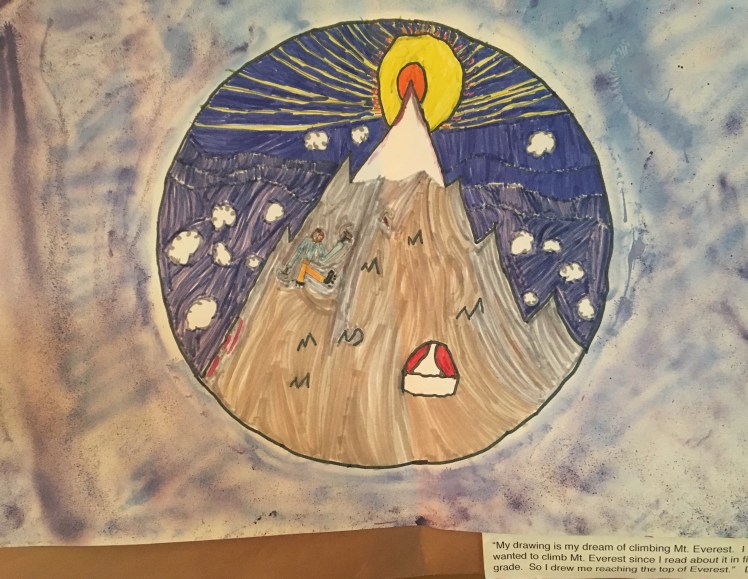
I only just started looking into this possibility but I’m optimistic that I will be able to arrange something meaningful in Nepal and apply for the regional travel grant. If so, that means I will get to visit two countries that have been on my wish list for a long time. Again, I’d want to plan some extra days in Nepal to see some of the sights, specifically Mt. Everest. In fourth grade my son had to do an art project about  dream he had for the future. He drew this picture of climbing Everest. Of course, we won’t be climbing Everest, but I think we can manage to arrange a visit to view the peak.

Drawing of Mt. Everest


Great Expectations…

I haven’t had any news from the US Embassy regarding my placement or arrival dates so this week I’ve just been pondering my own expectations for the experience.  Whenever I travel, I try to go into the experience with an open mind.  Even though I’ve admitted that I’m a planner, I find that being open to having new experiences is the key to avoiding frustration.

Several people have asked me what I expect the experience to be like living and teaching in a very different culture, with an unfamiliar language, customs, and foods.  To be honest, I don’t have a lot of expectations. I’m intentionally trying to let go what my own ideas of what the experience should be so that I can simply be open to what the experience actually is once I’m there.

Still, I do have some expectations. It’s impossible not to. So, I thought it would be worthwhile to list some of them here and then come back around to this once I’m in Uzbekistan and reflect on how the real experience compares to my vision right now of what it will be.

I expect to be challenged, a lot, on many levels. Here’s a few:

Just getting there is going to be a challenge. So far the shortest trip I have found has two layovers and takes 25 hours.

We are going to have to accomplish several important things in the first few days in Uzbekistan, not the least of which will be finding an apartment for the 5 months in country.

We also will need to sort out using the metro because we won’t be driving while in Uzbekistan. I find public transportation to be intimidating. In Minnesota, we pretty much drive everywhere because public transportation isn’t very good. It just hasn’t been developed here so doing simple things like reading the bus schedule or figuring out which side of the train platform I need to be on are scary to me.

Food. Food is most definitely going to be a challenge. The people who know me well, already understand this. I’m fussy. I tend to like the stereotypical Midwestern diet; bland food that is focused on meat and starch. Luckily, I’ve heard that the Uzbek diet is very meat heavy. On the down side, that meat includes horse. Um…I cried the entire time I was reading the Red Pony in my 9th grade English class so that’s gonna be a challenge.

But the biggest challenge I foresee is teaching. Not so much the teaching, but the communicating. As you already know, I only speak a few phrases in Russian and I speak ZERO Uzbek. I’ve been told that most of the students will speak little English. That means I have to have a translator. I teach in English, which then gets translated to Russian and maybe even to Uzbek. I anticipate this is going to be a struggle.

One of the reasons I love teaching is the interactions that I get to have with my students. My classes are very interactive. I love to discuss with my students, rather than lecture to them. If I have to wait for everything to go through a translator (or even two!) and back again, that’s going to seriously disrupt the flow of my classes.

But this all sounds like I’m expecting bad things… I have great expectations too.

I expect to travel, not just around Uzbekistan, but to other countries in the region as well. I expect to meet interesting people, make friends and professional connections, learn a lot of Russian and hopefully a little Uzbek. I expect to wonderful and challenging adventure and come home with lots of stories to tell.

Finally, I expect that my expectations will largely be wrong.

School Days, School Days…

As I mentioned in my previous post, one major decision that has yet to be made is our schooling options for my son.  One factor complicating this is that I don’t know my exact placement in Uzbekistan. It is likely that I will be in the capital of Tashkent but it is also possible that I will be placed at a University outside of the capital in one of the regions.

My contact at the US Embassy in Uzbekistan has said that I may get my final placement until December because the Uzbek Ministry of Education has the final say over all placements. Since the spring semester doesn’t begin until February, they may not decide upon by placement until December.  EEK! As a planner, this makes me a bit nervous.

If I’m placed in one of the regions outside of the capital, my only option will be to home-school my son. I’m not sure how well this would work. I’m confident that I could teach him the needed material and his current school has offered to work with me on the curriculum. That’s not my concern. If I home-school my son he won’t have the same opportunities to interact with kids his age and I am concerned that it will be difficult for him to make friends. It will be a fundamentally different experience for him.

My hope is that we will be placed in Tashkent, because there are three international schools available within the capital. The most highly regarded one is the Tashkent International School (TIS). This school came highly recommended by a previous Fulbright Scholar who was in Tashkent with her family. TIS is an American style school. They go to school Monday-Friday, have numerous after school activities, and students don’t wear uniforms. I mention these things because they are all important items on my son’s school screening list.

Check out the Tashkent International School (TIS)  here.

Another option is the British School of Tashkent. Initially, my son was excited about this option because he loves to speak with a fake British accent and figured he could really perfect it if he was at a school with British teachers. Then he discovered that they have school Monday-Saturday AND the students have to wear uniforms. Either one of these things alone would be a tough sell. I’m pretty sure that together they are a deal-breaker, but we will still check into it because, you know, it’s British.

Learn more about the British School of Tashkent here.

The third option is the Tashkent Ulugbek International School.  I hadn’t come across this school in my own online searches for some reason. My contact at the US Embassy sent me a list of International schools in Tashkent and this school was included. I don’t know much about it and haven’t heard of any previous Fulbrighters who sent their kids to this school.

To learn more about the Tashkent Ulukbek International School click here.

I’m confident that we will get this all sorted out before we arrive in country. I’ve already been in touch with the admissions directors at TIS and the British School and both were very responsive. My son’s current school is also really excited that he gets to have this unique international experience. They have been very supportive and even offered to enroll him in their online option if need be, but that’s really a last resort option.

In the end, the most important thing to me is that he have a good experience, makes some friends, and learns about an entirely new culture. He will learn so much just from the experience and I’m excited for us to have this adventure together.

Logistics…

One of the biggest challenges I’ve faced since I found out I received the Fulbright grant is to figure out how I can actually be gone for a semester from my regular teaching gig.  You see, most faculty would apply for a Fulbright grant at the same time that they are applying for a sabbatical. But I’m not most people and I’m not so good at waiting when I’m really excited about doing something. I am not eligible for a sabbatical for several more years and as I said, I’m impatient, so I just applied for the Fulbright grant and left sorting out the details of how I’d take the leave of absence until later (which is now.

Luckily, I live in Minnesota, which is Union country. We have strong unions, especially our teacher’s union. I’m a member of the MN State College and Faculty (MSCF) Union. While not perfect, we have a strong contract which allows for faculty to apply for an unpaid leave of absence. After numerous meetings with my union rep and the HR Director, we figured out a way for me to take a partial unpaid leave and still keep my health insurance. I’ll be on unpaid leave, so I’ll only be getting about 2/3 of my salary for the year but I’m grateful to have this option.  Also, the Fulbright grant include a monthly stipend which will cover about half of my lost salary for the spring semester.

I have talked to other community college Fulbright scholars and alumni who had a much more difficult time arranging leave. One person wasn’t sure he was going to have a job to come back to after his Fulbright and another, after much negotiation, was able to get his community college administrator to guarantee that his job would be safe when he returned the next fall.  In part, this is because many community college faculty don’t have the option to take a sabbatical. Again, I’m not using this benefit right now to do my Fulbright grant, but I’m grateful to my union that we have sabbatical leave in our contract.

Another major decision is if my family will be coming to Uzbekistan with me and if so, for what portion of my grant. The Fulbright program is at heart a cultural exchange program. As such, they encourage families to go with the Fulbright scholar and they even include additional funding to cover dependent travel and living expenses.

I think if I had been selected for a grant in Barbados, there would have been no question that my husband and son would accompany me. Uzbekistan took a little more contemplation. I left the decision about coming with me up to each of them independently. My son decided that he’d like to come with me for the entire 5 months. Yeah!

Unfortunately, my husband can’t just up and leave his job for 5 months. He can work remotely but given the 10 hour time difference between Minnesota and Uzbekistan working long-term from there wasn’t practical. He will have to use all his vacation time to come visit for about a month. I’m hoping that we can do some travelling around the country while he visits.

The next big decision facing us is to figure out the best schooling option for our son while he is with me in Uzbekistan. I’ll say more about that next week.

I Meet the Family (AKA Pre-departure Orientation)

Have I already mentioned that I’m a planner? I love to plan things; parties, events, trips, whatever. I actually enjoy the process of planning out every little detail of our family vacations.

One of the best things that the Fulbright program does is to bring all the new scholars to a particular region out to Washington D.C. in July for a three day pre-departure orientation (PDO).  This was an excellent opportunity for me to get to know the other scholars and students heading to Uzbekistan, as well as, talk to alumni from the Central Asia region. I was really excited to attend this orientation and had a list of questions I wanted to ask Beth (she had just returned from Tashkent two weeks earlier) and the other alumni.  This PDO is a planners dream.

Sometime in January, during the application review process, I received an email telling me to save the dates July 18-20 for the PDO, which I would be required to attend should I be selected for a Fulbright grant. This was a good thing because I found out about my grant very late in the process. I signed my grant details on June 13, about a month before the PDO.  I hadn’t received any details about this PDO so I emailed Richard, my contact person at Fulbright, to ask about making the travel arrangements.

One thing I should say about the entire Fulbright program staff is that they are very responsive.  Just like when I emailed the previous Fulbright scholars, anytime I emailed staff I received a response very quickly with the information I needed.

Richard responded the same day with an apology for the lack of information and said that the travel coordinator would be sending me information on how to register for the PDO and a link to book my flights. The entire process went pretty smoothly. Fulbright paid for my flight to and from DC but I was able to select my itinerary myself using their online booking system.

The PDO itself was incredible well organized. I’ve planned some smaller scale events similar to this one so I understand the hours of work that goes into something like this. It was held at the J.W. Marriott in DC, which is a beautiful hotel with views of the Washington monument.

They had sessions planned about everything you could possibly want and even some I hand’t considered, like how to tell your Fulbright story. (That’s where the idea for this blog came from.) We started with an opening dinner reception. At the dinner we were assigned to tables by country so I immediately got to meet the other people who will be in Uzbekistan this academic year. I sat next to Jordan, a recent college grad, who is going to Uzbekistan to be an English Teaching Assistant (ETA). We bonded over our mutual love of the same podcast and a Lululemon travel purse.

Over the next two days I learned about central Asia and specifically Uzbekistan from experts at the State Department and former Scholars from the region. We had sessions about practical things like signing up for health insurance and overcoming culture shock. Time was set aside for us to just chat with alumni from the region about whatever questions we had. I got to talk to Beth about the school options for my son in Uzbekistan, ask her about how to get my cell phone to work there, and discuss which neighborhoods would be good live in.  She even told me the name of her favorite pizza delivery place! (Yes, apparently there is good pizza in Uzbekistan.)

I also made friends with some previous scholars who I’ve been emailing with since the PDO. One of them offered to help me put together a regional travel grant to Nepal. One of the benefits of the Fulbright program to central Asia is that they offer the opportunity to apply for a regional travel grant so scholars can travel to another central Asian country for 3-14 days. I’m working with Rebecca, who received a travel grant last year, to write up a grant to visit Nepal.  I’ll definitely keep you all posted on that process!


ты говоришь по русски?

No, I don’t speak Russian, but they do in Uzbekistan. To be clear, the ability to speak Russian isn’t required for a Fulbright grant in Uzbekistan. Each award in the Fulbright catalog includes grant details like if language proficiency is required. I only considered countries that had no language requirement. I love the idea of speaking another language but even after 4 years of high school Spanish, plus one semester in college, I can barely have a conversation. I can however, ask where the bathroom is and order at a Mexican restaurant.  I can NOT do either of these in Russian.  So I’m going to need to learn some basic Russian, not for teaching, but for survival.

At this point in my preparation, I can say about three things in Russian:  да (yes), нет (no), and водка (vodka).  While useful, I don’t think that’s going to cut it. Luckily, Michael, the previous scholar from Uzbekistan with whom I was in touch, happened to know a Russian woman who now lives in my area and put me in touch with her. Turns out that she is a former Russian professor and was willing to give myself and my son private Russian lessons.

I knew immediately that I was going to love this woman. At our first lesson she showed us this video and told us that our homework for the week was to practice speaking with a Russian accent.


You can guess how long it took before my husband got tired of being asked, “Vot do you Vant for dinner?”

I’ve now had four lessons and have covered some essentials. I admit that I have been struggling with the alphabet. I’ve made up my own little mnemonic devices to help me remember some of the letters.  I’m doing okay with most of the new letters that I’ve never seen before, such as this one that I call a “Russian asterisk” which sounds like “zhu” or the S in treasure.

Related image

Other letters are easy because they are the same as in English, like M and T.  But then there are the tricky ones that look like English but are something else entirely in Russian. For example, when I see this letter: P, my brain think the P sound in English, like in Papa. Except that’s entirely wrong! In Russian, this letter is the R sound, like in Red. And to make matters worse, in Russian you have to roll your R sound!

Want to try a Russian tongue twister with the R sound in it? Click here.

One of the first words Natalia taught us was Hello, which in Russian is Здравствуйте. That looks pretty intimidating! But the wonderful thing about Russian is that is phonetic so as long as you can keep those letters and their sounds straight, you can sound out any word.

Здравствуйте = Zdravstvuyte 

Easy, right?

Yeah, not so much. I’ve decided to just use the informal version, привет (privet).

Right now my teacher is back in Россия visiting her family so we are studying on our own.  A friend gave us his copy of Rosetta Stone to use. I’ve often wondered how well this program works.  Now I get to see for myself. I’m only on lesson two right now, but I’ll definitely report back in a few months on how well the program works for me.

Between my formal lessons, Rosetta Stone, and an app on my phone I’ve learned to say the following things:

  • Hello. (both formal and informal)
  • Goodbye. (both formal and informal)
  • Nice to meet you.
  • My name is… What’s your name?
  • Boy, girl, man, woman
  • Cat, dog
  • Good morning, afternoon, night
  • I am American.
  • Where?

I also know how to say Bread, Vodka, Gin, and Liquor. I wonder who programs these apps because these don’t seem like the most crucial words for me to learn.

Just to be clear, I have no grandiose ideas of becoming fluent in Russian in just 6 months, but I’m still hanging on to the notion that I can learn enough to not immediately be pegged as the American.

до свидания!


The Fulbright Family

I have to be honest, I was pretty disappointed to learn that I didn’t get selected for the spot in Bhutan.  I told my husband and my letter writers and then tried to just let it go. A few people asked me if I had heard anything and I had to tell them the bad news but mostly no one asked about it.

Then, on a random weekday between classes, my office phone rang.  I answered expecting it to be one of my students concerned about their upcoming final exam. I was shocked to discover it was a person from the Fulbright office.

Wait, what?

That’s right, someone from the Fulbright office was calling me to discuss my application. She wanted to know if I was interested in considering a different country.

A different country?  This was sure unexpected. I think I may have stammered a little before taking a breath and asking her, “Which country?” Of course, if you’ve been following along since the beginning, you already know the answer to this question.

Uzbekistan.

Okay, I’ll admit that I was a little thrown off at first by this. I may have looked something like this…

38904821_1194952114016447_5464846087405699072_n
photo credit @AnitaLynn

I really shouldn’t have been surprised by this. After all, the application process did have an area where I could put in other country awards that I would consider if I didn’t get my first choice.  At the time I was filling out my application, I thought, “Why not put down some alternate options?” They put that in the application so I might as well find some other awards to include. The application had space for up to three alternate awards that all fit my qualifications. The first award I put down was Macedonia, because that just sounded like an interesting place to visit. The second one was Barbados, because, well, come on, I live in MN and January gets pretty cold here. The third option I included was, you guessed it, Uzbekistan!

I probably shouldn’t be telling you this, but I never really expected to be offered my third alternate so I didn’t put much time into researching the Uzbekistan award during the application process. So when the woman on the phone asked me if I would be interested in Uzbekistan, I really didn’t know anything about it. Still, it was a Fulbright grant and I’m always one to take on a new adventure, so I said, “Absolutely!”

She explained that she would have to forward my application to the Uzbekistan team for review and they would be in touch in a week or two to let me know if I was selected. So, back to that waiting game…

In the meantime, I went straight to the Fulbright directory and searched for scholars who had been in Uzbekistan. I found the person who was there at that time and the person who and just returned and fired off an email to both of them asking if they’d be willing to talk to me about their experience in Uzbekistan.  Of course, they did not disappoint. Both Michael and Beth replied to my email within a day and offered to chat by phone to answer my questions. More than anyone else, these two Fulbright alumni have helped me. I am still in contact with both of them.

Now would be a good time to talk about the Fulbright family. I first heard this phrase when I was talking to my colleague who’d been in Hungary. He told me that he’d be more than happy to talk with me about the application process. He said that now that he was a member of the Fulbright family part of his role was to help other scholars. This sentiment pervades everything associated with the Fulbright program. Every scholar,  staff person, student scholar, really every one I have interacted with has been incredibly welcoming and more than willing to help. It truly does feel like family.

A family that I honored to be a part of now.

A few weeks passed before I received the email with the now familiar attachment. This time the letter stated that I had been offered a Fulbright grant to teach in Uzbekistan and that I would receive the specific grant details in 1-2 weeks.

I was a Fulbright scholar and I was going to Uzbekistan. Now I just needed to figure out what exactly I needed to do to start preparing. One thing I did know was that I was going to need to start learning Russian…


The Waiting Game…

Let’s talk a little bit about the Fulbright timeline. It’s a very long process from beginning to end. If you recall from my previous posts, I first looked into the Fulbright program during the 2015-2016 academic year. I wasn’t ready to apply by August 1, 2016 but did get my application submitted in the next round. With my application submitted by the August 2017 deadline, I couldn’t do anything other than wait to hear back from the Fulbright committee.

According to the Fulbright website, the first round of application reviews are done by peers in your discipline who make a recommendation to the Regional Fulbright Committee sometime in Sept-Oct. The Regional committee then meets in DC sometime in Oct-Nov. to decide which applications will be forwarded along to the host countries. Applicants don’t hear anything about the status of their application until this process is completed in November or December.  That means I have 4-5 months to wait.

So….while we wait, why don’t I circle back to that email I sent to the previous Fulbright scholars in Bhutan. As I said, I felt uneasy about reaching out to them via email. For some reason, as small part of me was worried that emailing them for information would make me appear less competent.  I am so glad I didn’t listen to that voice. Reaching out to the Fulbright scholars who had been in Bhutan was tremendously helpful. I reached out to the scholar who was in Bhutan at that time (Spring 2017) and to another person who had been there a few years earlier. Both were Psychology professors and both replied to my email that same day with offers to set up a time to chat via phone.

I spoke with both of those scholars, one of whom was still in Bhutan when he called me. Both were incredibly friendly and more than willing to talk with me about their Fulbright experience. (more on this later) In fact, they gave me such helpful information that I substantially revised my project proposal after speaking with them. (Remember that I spoke with them in March-April and didn’t submit my completed application until July, 2017.) If you are considering applying for a Fulbright grant, you should definitely reach out to former Fulbright scholars. Their insight could be invaluable.

Alright, where were we before I took that diversion? Oh right, waiting…

I tried to put it out of my mind but as November came closer I found myself checking my email more frequently than usual and by usual I mean about 10 times a day.  According to the official Fulbright website, applicants will be notified in November-December as to whether or not they passed the first round of review. Well, November came and went and I hadn’t heard anything. I was truly starting to worry that I hadn’t made the first cut.

Want to see the Fulbright timeline for yourself? Check it out here.

From the beginning of this process I played my cards close to the vest. Outside of my husband and the people who wrote the letters of recommendation for me, I didn’t tell anyone that I had applied for a Fulbright grant. This isn’t so much because I was afraid I’d “jinx” it but more because I didn’t want to have to go back to all those people and tell them I did NOT get selected, if that ended up being the case.

Finally, on December 11, 2017, when I was just wrapping up final exam week of the fall semester, I received the email I had been waiting for.  The email simply said that the first round of application reviews had been completed and then referred to an attached letter. If only this had been a paper letter. I would have torn into it and thrown the envelope on the floor while frantically trying to unfold the letter. As it was, this was an email so it was a little less dramatic. I just clicked on the attachment and opened the .pdf file. Here’s a screenshot of that file:
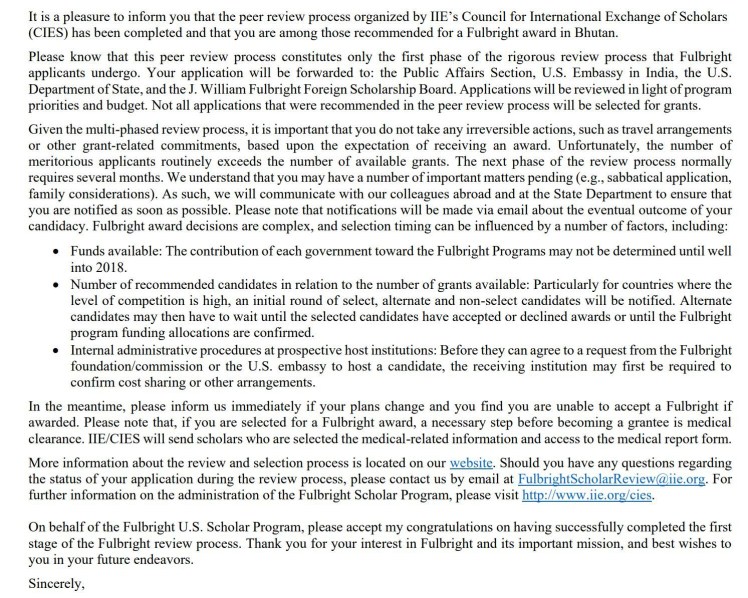
letter.jpg

So I made it past round one! Yeah! Now I started to cautiously tell a few people here and there about my application. I made it past the peer review process in DC and now my application was being sent to Bhutan along with all the other finalists. I had no idea how many of us there were, but I did know that there was only 1 spot in Bhutan for a Fulbright scholar.  Each time I told someone about my application I would add the caveat that Fulbright grants were highly competitive and that there was only one spot in Bhutan but still, I was optimistic about my chances. And I was back in the waiting game…

January…February… No word…March.. Still no word. According to the Fulbright timeline the in-country review process happens from Nov-April, which is a really big window when you are the one obsessively checking you email for news.

Finally, on April 12, four months after my first email, I received the message I had been waiting for, with the results of the final in-country review process. Unfortunately, this attached letter did NOT have the news I had been hoping for.  This was a rejection letter:
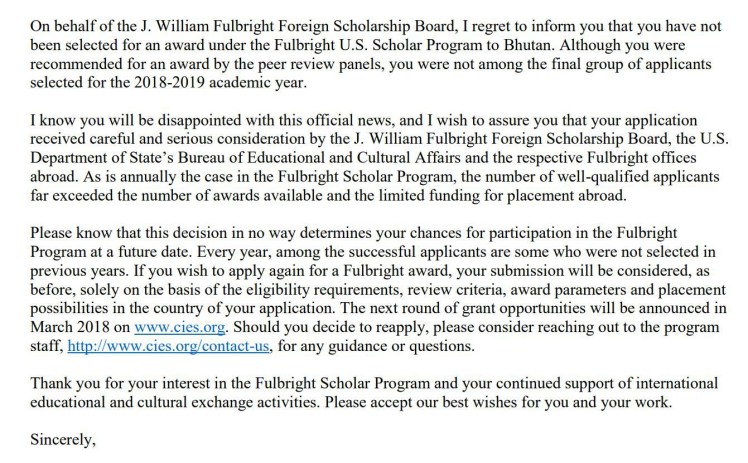
rejection.jpg

I know what you are thinking, “But Laurie, I thought you received a Fulbright grant! I’m confused. What happened? Why are you writing this blog and why did you say you are going to Uzbekistan.”

Those are all great questions… that I will answer in my next blog post so stay tuned!