The Waiting Game…
Let’s talk a little bit about the Fulbright timeline. It’s a very long process from beginning to end. If you recall from my previous posts, I first looked into the Fulbright program during the 2015-2016 academic year. I wasn’t ready to apply by August 1, 2016 but did get my application submitted in the next round. With my application submitted by the August 2017 deadline, I couldn’t do anything other than wait to hear back from the Fulbright committee.
According to the Fulbright website, the first round of application reviews are done by peers in your discipline who make a recommendation to the Regional Fulbright Committee sometime in Sept-Oct. The Regional committee then meets in DC sometime in Oct-Nov. to decide which applications will be forwarded along to the host countries. Applicants don’t hear anything about the status of their application until this process is completed in November or December. That means I have 4-5 months to wait.
So….while we wait, why don’t I circle back to that email I sent to the previous Fulbright scholars in Bhutan. As I said, I felt uneasy about reaching out to them via email. For some reason, as small part of me was worried that emailing them for information would make me appear less competent. I am so glad I didn’t listen to that voice. Reaching out to the Fulbright scholars who had been in Bhutan was tremendously helpful. I reached out to the scholar who was in Bhutan at that time (Spring 2017) and to another person who had been there a few years earlier. Both were Psychology professors and both replied to my email that same day with offers to set up a time to chat via phone.
I spoke with both of those scholars, one of whom was still in Bhutan when he called me. Both were incredibly friendly and more than willing to talk with me about their Fulbright experience. (more on this later) In fact, they gave me such helpful information that I substantially revised my project proposal after speaking with them. (Remember that I spoke with them in March-April and didn’t submit my completed application until July, 2017.) If you are considering applying for a Fulbright grant, you should definitely reach out to former Fulbright scholars. Their insight could be invaluable.
Alright, where were we before I took that diversion? Oh right, waiting…
I tried to put it out of my mind but as November came closer I found myself checking my email more frequently than usual and by usual I mean about 10 times a day. According to the official Fulbright website, applicants will be notified in November-December as to whether or not they passed the first round of review. Well, November came and went and I hadn’t heard anything. I was truly starting to worry that I hadn’t made the first cut.
Want to see the Fulbright timeline for yourself? Check it out here.
From the beginning of this process I played my cards close to the vest. Outside of my husband and the people who wrote the letters of recommendation for me, I didn’t tell anyone that I had applied for a Fulbright grant. This isn’t so much because I was afraid I’d “jinx” it but more because I didn’t want to have to go back to all those people and tell them I did NOT get selected, if that ended up being the case.
Finally, on December 11, 2017, when I was just wrapping up final exam week of the fall semester, I received the email I had been waiting for. The email simply said that the first round of application reviews had been completed and then referred to an attached letter. If only this had been a paper letter. I would have torn into it and thrown the envelope on the floor while frantically trying to unfold the letter. As it was, this was an email so it was a little less dramatic. I just clicked on the attachment and opened the .pdf file. Here’s a screenshot of that file:
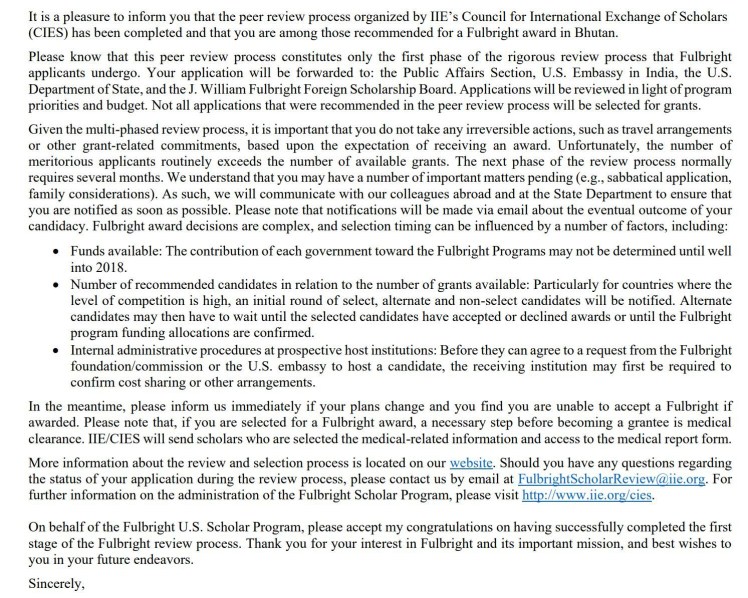
So I made it past round one! Yeah! Now I started to cautiously tell a few people here and there about my application. I made it past the peer review process in DC and now my application was being sent to Bhutan along with all the other finalists. I had no idea how many of us there were, but I did know that there was only 1 spot in Bhutan for a Fulbright scholar. Each time I told someone about my application I would add the caveat that Fulbright grants were highly competitive and that there was only one spot in Bhutan but still, I was optimistic about my chances. And I was back in the waiting game…
January…February… No word…March.. Still no word. According to the Fulbright timeline the in-country review process happens from Nov-April, which is a really big window when you are the one obsessively checking you email for news.
Finally, on April 12, four months after my first email, I received the message I had been waiting for, with the results of the final in-country review process. Unfortunately, this attached letter did NOT have the news I had been hoping for. This was a rejection letter:
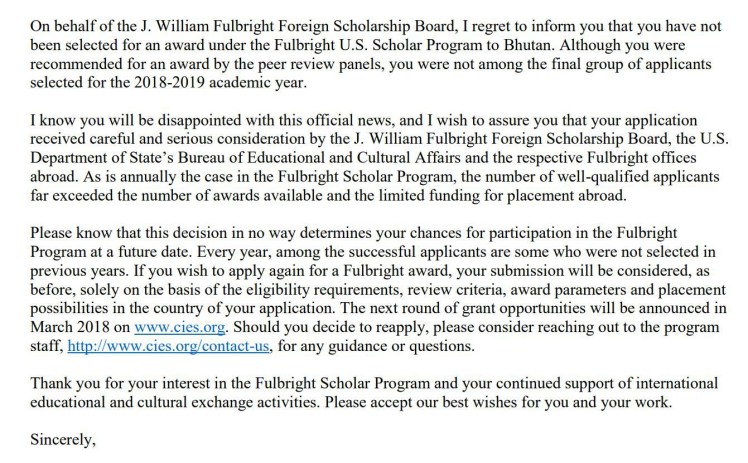
I know what you are thinking, “But Laurie, I thought you received a Fulbright grant! I’m confused. What happened? Why are you writing this blog and why did you say you are going to Uzbekistan.”
Those are all great questions… that I will answer in my next blog post so stay tuned!

 Experience Fulbright